Natural Born Heroes: Mastering the Lost Secrets of Strength and Endurance
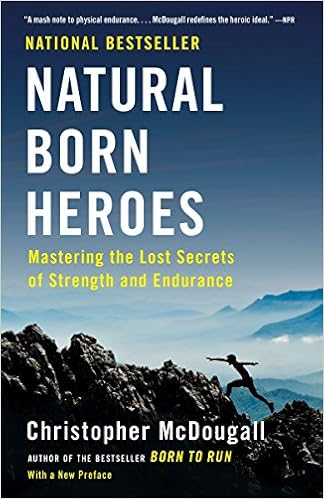
After running an ultramarathon through the Copper Canyons of Mexico, Christopher McDougall finds his next great adventure on the razor-sharp mountains of Crete, where a band of Resistance fighters in World War II plotted the daring abduction of a German general from the heart of the Nazi occupation. How did a penniless artist, a young shepherd, and a playboy poet believe they could carry out such a remarkable feat of strength and endurance, smuggling the general past thousands of Nazi pursuers, with little more than their own wits and courage to guide them?
McDougall makes his way to the island to find the answer and retrace their steps, experiencing firsthand the extreme physical challenges the Resistance fighters and their local allies faced. On Crete, the birthplace of the classical Greek heroism that spawned the likes of Herakles and Odysseus, McDougall discovers the tools of the hero—natural movement, extraordinary endurance, and efficient nutrition. All of these skills, McDougall learns, are still practiced in far-flung pockets throughout the world today.
More than a mystery of remarkable people and cunning schemes, Natural Born Heroes is a fascinating investigation into the lost art of the hero, taking us from the streets of London at midnight to the beaches of Brazil at dawn, from the mountains of Colorado to McDougall’s own backyard in Pennsylvania, all places where modern-day athletes are honing ancient skills so they’re ready for anything.
Just as Born to Run inspired readers to get off the treadmill, out of their shoes, and into the natural world, Natural Born Heroes will inspire them to leave the gym and take their fitness routine to nature—to climb, swim, skip, throw, and jump their way to their own heroic feats.
Reviews (185)

Read This at the Perfect Time
This book came to me at a perfect time: I was overtraining and I needed to take a breather (to be more specific, my body had forced me to do so). I get all up in this book's face in 2 different ways: (1) The nutritional "diet"/ training it speaks about, and (2) the backstory that blankets the entire book. (1) I know little to nothing about nutrition, and shouldn't be trusted very much in regards to advice in that arena, but the book has steered me in a right direction in terms of changing the foods that make up my daily diet---what to limit, what to increase---and that (among other recommendations from actual trainers) has drastically improved not only my athletic performances, but I just simply feel healthier. Like McDougall suggests we all do, I'm just trying to get to a state of holistic health to where I can function like, well, a kid in a playground. To that end, his writings are incredibly thought-provoking and damn-near mindblowing. (2) The unbelievable story of a bunch of rag-tag nobodies kidnapping a Nazi high-ranking officer already has my attention (and I'm sure McDougall is keenly aware of how cool this story is), and tale itself from beginning to end is as captivating as you might imagine. Great job of teasing it out. Toward the latter parts of the book, I thought that some of the time-jumping (you switch between his present-day adventures, WWII, and sometimes somewhere in between) got confusing, and it made me do some re-reading in case I glossed over some important points. Not a deal-breaker for me, but thought you should know. In the end, I think that this book has a TON of information about eating/fueling/exercising in a notably different way than I'm used to, but it is also bursting at the seams with little asides for subjects that could have their own book of this size or even greater (Crossfit movement, why humans were so successful at hunting, heart rate training, performing athletically under said proper heart rate, extracting essential foods from your local surroundings, etc.). I would heartily suggest that you read this and use it as a springboard to other subjects within that interest you. McDougall's book has set me on a course of heart rate training that I had been postponing for years, and I can say without question that I'm an improved athlete and a healthier person due to his research and experiences. Is this for everyone? Why, of course not. Each athlete has their own set of eccentricities and particular things that their body responds positively to, and I would humbly ask that you take that into account if you execute anything within here. Remember: even if you hate exercise, it's got one hell of a WWII story, so there's that.

How the Allies Won The War!
I think someone said that the farther we get away from historical events the better we understand them. World War II is almost beyond living memory now and yet stories keep emerging about till now unsung but consequential contributions to the Allied effort – the effort that kept the world from coming under the thumb of Hitler and his Third Reich. One such story is the battle for Crete. And that story, fantastic as it is, serves as the backbone of Christopher McDougall’s latest book, Natural Born Heroes. McDougal came to fame as an author with the success of his first book, Born To Run, which told the story of an obscure, hidden indigenous tribe somewhere in the wilds of Mexico that produces men who are able to run unbelievable distances at unbelievable speeds – without shoes. Like that book, Natural Born Heroes is also concerned with local, untrained men who are able to accomplish almost unbelievable physical feats. I would describe this book as layered. It’s not strictly chronological. It weaves back and forth between the main story – the capture of a German General during the occupation of Crete during World War II – and stories about Greek culture and the daily lives of the type of men who carried off this breathtaking capture and escape. The book is filled with stories about the various kinds of physical and dietary regimens being discovered and practiced today that mimic or approximate the native lifestyle of the hardy Cretan. He writes about Parkour, primal eating and various kinds of self-defense systems. I read a lot of books, but it has been a long time since I enjoyed a book so thoroughly. I found myself making time in my days to get back to it and looking forward to the hours set aside for it. The story of the battle of Crete is enough, in and of itself, to rivet one’s attention. As the book tells us, when Hitler’s Chief of Staff was being tried for war crimes, he blamed the loss of the war not on the resolve of the British or the entry of the Americans intro the European theater but on the dogged resistance of the Cretan citizenry whose efforts stymied the German plan for immediate subjugation. Hitler had planned to move his armies to the Russian front in the spring and defeat the Russians in battle there before the terrible winter set in and his troops be caught in ice and snow. But the Greeks gave him more trouble than he ever imagined. In fact, it took longer for Germany to establish its command on the tiny island of Crete than it did for them to conquer France. Because of the resistance of the Cretans, Hitler was not able to move his armies to the Russian front in a timely way and because of that they did get mired in the awful Russian winter and because of that they lost on the Russian front and, according at least to Hitler’s number one man, because of that , they lost the war. That is saying a mouthful: that the freedom that the world has enjoyed for the last seventy years or so is due in large part to the pranks and hardheadedness of a local citizenry that prevailed against incredible odds. But the other stuff is great, too. The forays back into the ancient history of Greece and Crete. The stories of King Minas and the Minotaur. The stories of Aristotle and Plato. The stories of Troy and Sparta; of Odysseus and Achilles and Ajax. McDougal has been criticized elsewhere for filling the book up with stories that are unrelated to each other. I disagree with that criticism. Even if the ancient myths and the character of the men who participated in the resistance in 20th century Crete are separated by millennia, it all makes sense to me. The past does matter and it does affect the character of a place and its inhabitants. The stories of modern day exercise and diet, even if not precisely the same as that of the Cretans, is nonetheless dramatic and informative. We ought to be stronger and more healthy than we are and this book is a kind of expose for why we aren’t and what we might do to improve our lot.

Prepare to go to unexpected places. It's all about the journey, not the destination.
What a journey, reading this book! I went to many unexpected places and met many new people. I know a book is good when I have to put it down for a bit, to pursue a particular twist in the narrative. My goodness! This is one of the very few books that I have read that will necessitate a second, slower, read. I have the Kindle version, and you should see all the highlights and notes! I love multi-disciplinary stories, and this book delivered, big time. The mainline of the story is the kidnapping of a German general during WWII (an amazing story, all by itself). From that baseline, we wind up visiting experts in nutrition, fitness, heroics (I know... "Heroics?" You'll understand when you read the book), physiology, psychology, etc. As a non-fiction author myself, I know what it is to exhaustively research something, and I was extraordinarily impressed with the range and depth of research for this book. This book has given me many things to do, things that will affect my life tremendously (already has!). Thoroughly recommended!

Long and Wandering
I've enjoyed all the books by this author even though he has a tendency to "wander" down other paths. This book had a great story to tell about the resistance on the island of Crete during World War II. About half way through I was skipping the pages with the Odyssey references. The first ones where ok but after that I felt like it was so far off from the story I didn't want to read anymore. The other "wanderings" where interesting, but towards the end of the book I just wanted to know, what happened to the resistance group on Crete????

"Ponder that, America."
I wanted to like this book and this author, as it was starting off great with interesting correlations of mythological Greek heroism to real life scenarios, fascinating abilities of the human mind, and unbelievable physiological feats of the human body, and so on. But the at the beginning of Chapter 6, pages 32-33, he writes about a rather vague WW2 possibility, or theory, in which Germany would conquer Russia via Hitler's Operation Barbarossa plan and become unstoppable, stating "...no power on earth could defy him.", and furthermore writing "...the Third Reich would have the biggest, fastest, best-equipped fighting force the world had ever seen." Those statements can be assumed possible but none the less are bold statements without presenting any numbers or hard facts, let alone the lack of considering other consequential factors(I explain below) that would have been equally safe to assume and possibly debunked those statements. But what ticked me off a tad and makes me wonder about his loyalism to the USA is when he goes further by writing these words immediately after, "Ponder that, America", with "that" in italics. I'm sorry? Isn't he American?!? That sentence sounds more like it's coming from someone who isn't American, or an American with a bit of resentment toward their home country. Regardless, those words, in my opinion, coming from a "Patriot", reflect a lack of loyalty and respect. For the sake of argument, let's "Ponder" his assumptive statements with some facts, figures, and consequential outcomes, something that he should have done when writing a book with such a bold claim... If the Operation Barbarossa theory was successful, I think it's just as safe to assume that at that moment the USA would have joined Britain, and other allies, in the war effort. McDougall goes on writing that the Japanese Navy and German U-boats would strangle American shipping. This theory fails to recognize the power of the Royal Navy in combination with US Navy. It also fails to mention the power of Royal and American Airforce and their influence on naval war at the time. Mind you the Royal Navy accounted for 1/3rd of the worlds Merchant Navy at the beginning of the war, and the USA's Navy became the largest in the world by the end of the war. Regardless of Japan's Naval size and the 1,000+ German U-boats(which were slow and couldn't stay under long), the power of Royal and American Navy and Airforce combined would have been at least an formidable opponent, if not overpowering. Let's be real though, this is all speculation, but McDougall fails to expose this as well. Let's not forget the US made the horrific decision to drop atomic bombs on Japan to ultimately end the war and most likely save many more thousands of lives. My heart goes out to all the innocent Japanese citizens killed during those two events, and equally to all other innocent people who lost their lives to the hands of Germans or any other army for that matter during the war. Let's also not forget the Holocaust, if it wasn't for the Americans making that cruel yet necessary decision to use atomic weapons who knows how many more Jewish captives would suffer or have been murdered. Yet McDougall states, "Ponder that, America". Well we just pondered that, and without America there's no telling how much worse the WW2 could have turned out, but I think it's safe to assume it could have been much, much worse. McDougall, if you read this, please explain what you mean with that statement. Please hear me in that I am not trying to be rude, or combative, or argumentative. I could be "reading" you wrong, I'm simply going with my intuition on what I have said in this review. To be honest I felt rather disturbed by that statement and somewhat responsible in voicing my opinion considering the unthinkable amount of sacrifice made by America and all people around the world during that terrible time.

Motivating, Highly Informative and Entertaining
I loved to read Christopher McDougall's Born to Run and I love reading Natural Born Heroes. Like in Born to Run, Christopher combines a fascinating story with superb advice for your body and health. I knew that Crete played a significant role in the fight against the Nazis, but I didn't know about these superhuman resistance fighters in the mountains. A few years ago, I hiked in the White Mountains in Crete and it's a beautiful landscape with remarkable people but hiking there can be tough (rocky paths, steep gorges, extreme heat in the summer). The advice/information—wonderfully integrated into the stories—is again (like in Born to Run) outstanding. It was an inspiration to rethink my exercise and nutrition. In terms of nutrition, I also recommend

A Diverse and Informative Book on Many Subjects
Many diverse ideas brought into a fascinating tale which cover from diet to how the people of Crete probably changed the outcome of WW2 making the German army's late leaving to invade Russia which led to their repeat of Napoleon's demise just short of Moscow as winter snows and freezing moved in. Their diet allowed them to be such fierce adversaries, for example, running double marathons through the mountains without eating. Junk scientific research misunderstood the Cretan diet which has now become the Mediterranean diet espoused by supposed diet experts. In fact In fact it was the rigid fasting regime of the Greek Orthodox Church and the high protein and high fat diet is what made them so metabolically strong. If interested in this aspect read Nina Teicholtz's book "Big Fat Surprise" which details how the misbegotten science came about creating the Mediterranean diet.

Both of thse books as some of the best I've read
I've read both Born To Run, and Natural Born Heroes by Christopher McDougall. Both of thse books as some of the best I've read, and are also two of the most influential books in my life. There is a lot of fascinating history of Crete packed into this book, along with just enough leads into fitness and diet to get anyone started on the right path towards truly changing their health for the best. His casual mention of some current day heroes would have me putting the book down to run to the computer, looking up the mentioned youtube video, or the person's name behind the story, which makes the book even more entertaining, and provides new paths to learn and follow far after the last page has been read.

Not as good as his first book, but still very worthwhile.
It's a strange mix of history and science/wellness, but for the most part, it works. If you enjoyed Born to Run and are curious about an underreported period of WWII history while wanting a bit more in the way of shocking stories of human performance this will scratch that itch.

Very confusing and inconsistent
This book feels like two stories being forced into one, leading to a book that feels inconsistent and without a good flow. If you loved “Born to run” you will find “Natural born heroes” very disappointing. Even with that, sometimes the stories grab your interest. Not enough to recommend reading it.


Comments
Post a Comment